How Paipasix Works in an Invented Card Game
Last updated
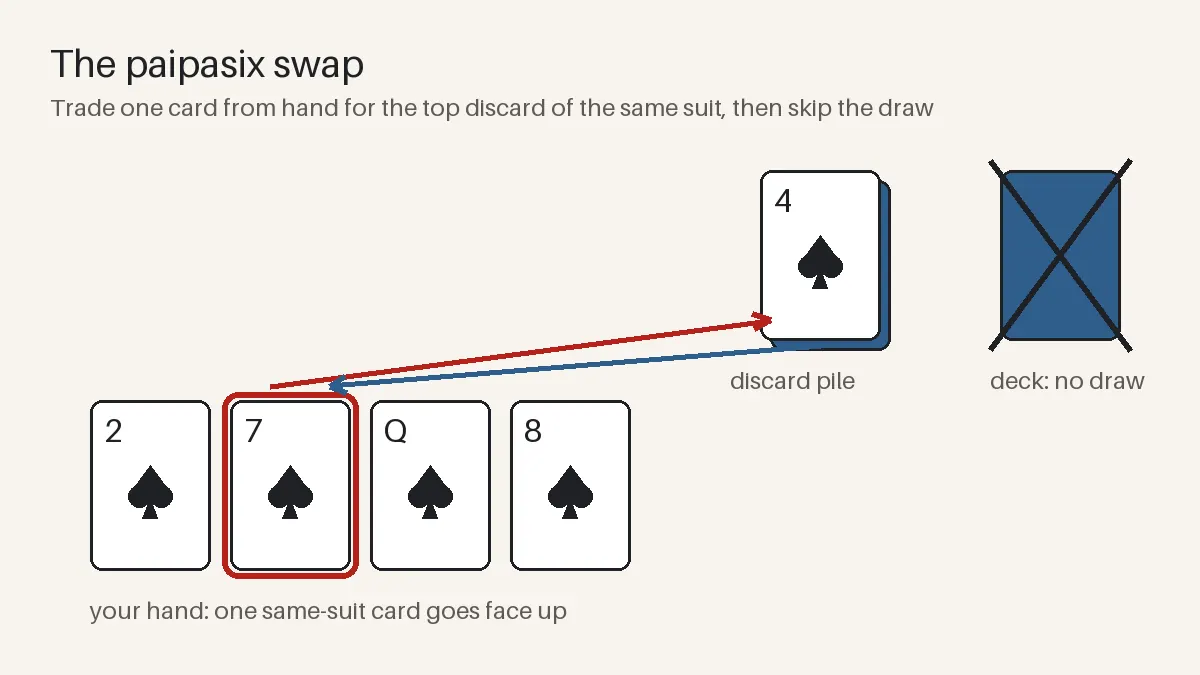
In a casual card game invented by players rather than published by anyone, paipasix is the term for a special exchange. On your turn, you may hand over one card and take the visible card sitting on the discard stack, as long as both belong to the same suit. The name itself is coined, chosen mostly because it sounds playful when shouted across a table.
There is a price for this privilege. Anyone who performs paipasix skips drawing from the deck that turn. That tradeoff is the heart of the move: you get a known card, but you lose the chance at an unknown one.
Timing and Frequency
The swap must happen right at the beginning of your turn, before you touch the deck. Say the word, place your chosen card face up on the discard stack, and take the card that was showing. Your offered card now becomes the visible one for everyone else.
You may do this only once per round. After the deal moves to the next person, each player regains the option.
Walking Through an Example
Imagine four friends sitting down to play. The dealer flips the first discard, the ten of diamonds. The player to the dealer's left holds the nine and jack of diamonds along with a lonely two of diamonds she has no use for. On her turn she says the word, slides the two onto the stack, and takes the ten. Her run of nine, ten, and jack is now complete, but she does not draw from the deck.
The next player looks at the two of diamonds she surrendered and decides it is no help, so he draws normally. That small exchange shows the whole rhythm of paipasix: one public card in, one public card out, and a skipped draw as the fee.
House Rules That Groups Often Add
Players adjust the details to suit their table. A few additions show up again and again.
- No exchange is possible when the discard stack has no cards on it.
- An illegal exchange, such as mismatched suits, is reversed and costs the player that turn.
- Jokers, if the group uses them, may be declared any suit for this move only.
- The move must be spoken aloud, and a quiet swap is treated as a mistake.
- Some tables cap the number of swaps per player across a whole game, not just a round.
Writing these choices down before you begin saves arguments later, especially when someone new joins and has never seen paipasix before.
Thinking Ahead When You Swap
Suppose you hold three hearts and the discard shows the heart you need to complete a run. That is the classic situation for paipasix, since the known card is worth more than a random draw. When the visible card is only slightly useful, drawing usually makes more sense.
Remember that your opponents see whatever you give away. Handing over a high card can feed the person to your left, so some players save paipasix for moments when the card they surrender is harmless. Others call it early to make the table guess what they are collecting. Learning when to hold back is a big part of getting comfortable with the game.